Job management for Australian trades
Know a job's going backwards while you can still do something about it.
Every hour and every part lands on the job at what it actually cost you, the minute it happens. So the margin moves while the job is still open — not six weeks later when the invoice is out and it's someone else's problem.
- You pay per job, not per bloke
- Your crew are free to add
- Runs on the phone in your pocket
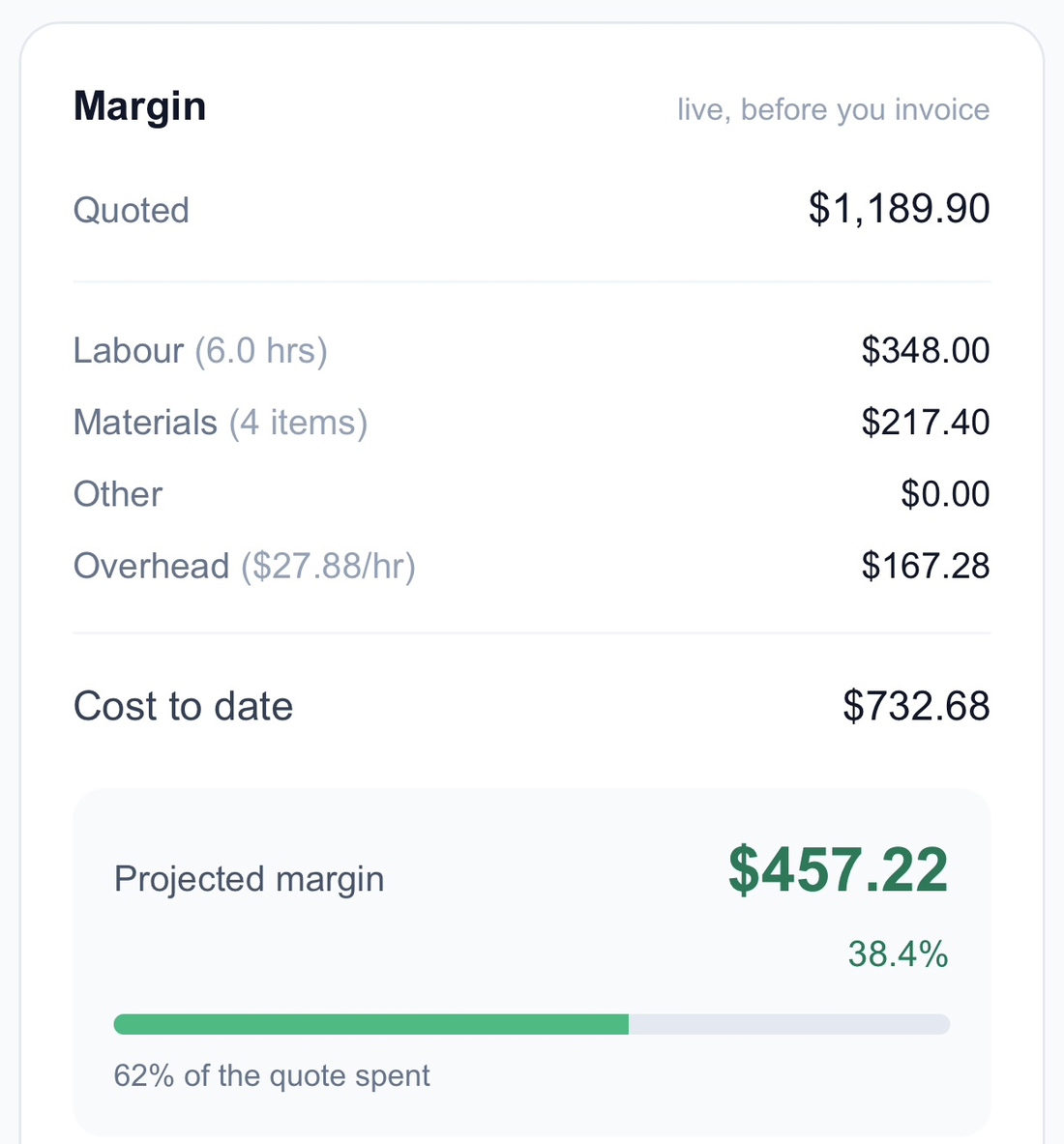
Timing belt and water pump. Quoted $1,189.90, $654.68 gone so far.
While the job is still open
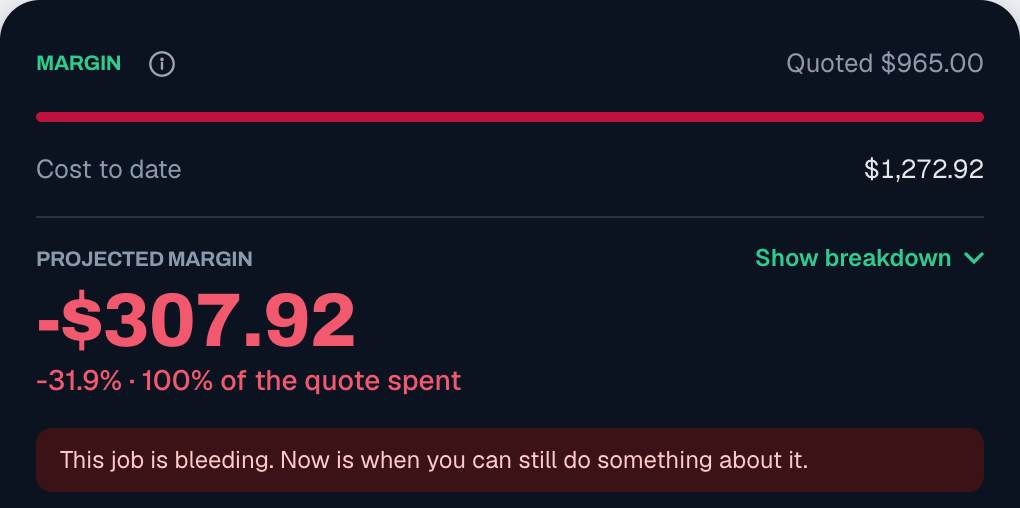
This one is $307.92 down.
You know that today.
Quoted $965. It has already eaten $1,272.92 in hours, parts and overhead. The alternator took longer than the book said and nobody rang the customer about it.
Right now you can still ring him, write up a variation, or wear it on purpose instead of by accident. In three weeks all you can do is wear it.
Most job software will show you this after the invoice goes out.
Which one are you?
The answer changes what you should care about here.
On your own
You quote at night off a gut feel.
You price it near enough to what you charged the last bloke for something similar. Whether that job actually made money, you find out in the accountant's office in October, by which time you have quoted forty more the same way.
- · Work out your real hourly cost once, then quote off it
- · Quote from the driveway before you drive off
- · One price for the whole business, even if it is just you
Two to ten on the tools
You cannot see a job's cost until the dockets come in.
Hours turn up on Friday for work done Monday. Materials turn up whenever someone empties the ute. By the time it is all in, the job is closed and the money has gone wherever it went.
- · Crew clock on from their own phones, costed as they go
- · They see the job. They never see what it makes
- · Put a fourth bloke on without the bill moving
Before you send it
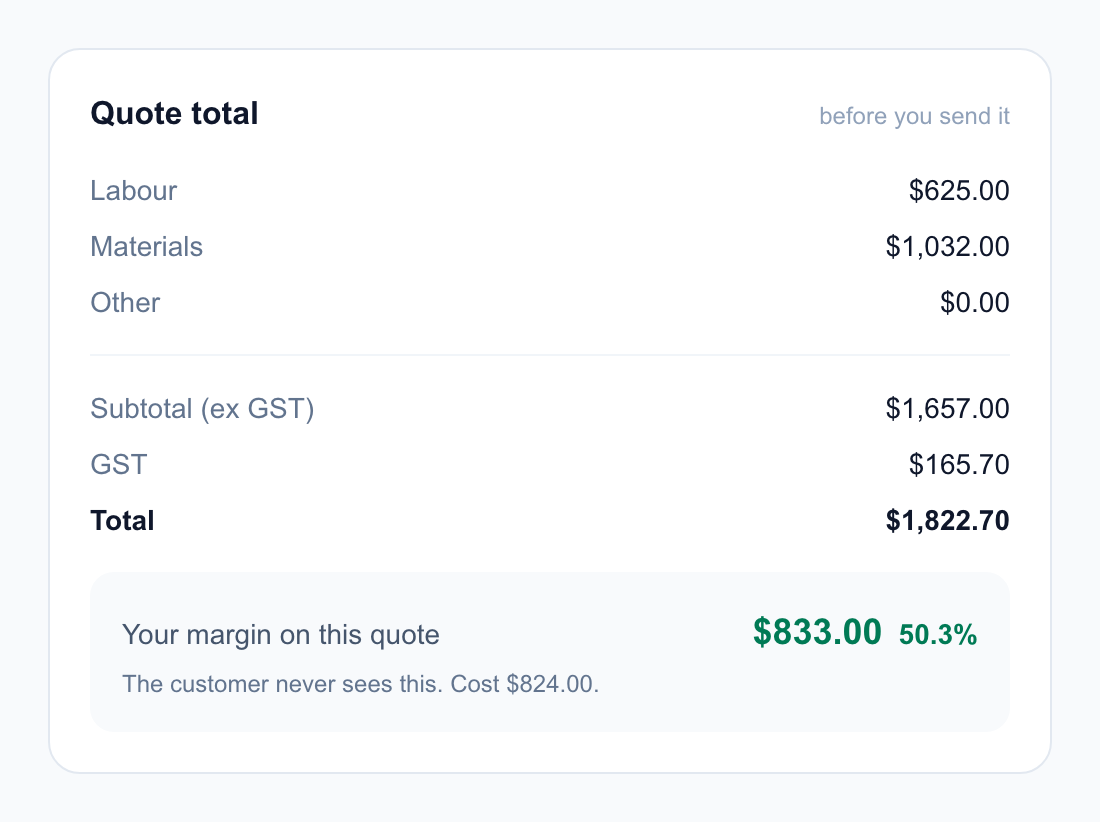
See what you make on it before he sees the price.
Build the quote off your own price list and the margin sits there while you are still typing. $300 of work, $170 of it cost you, $130 left. Move a line and the number moves. He only ever sees the $330.
GST worked out once on the total, the way your BAS wants it.
Live job costing
Six hours and four parts, on the job, by smoko.
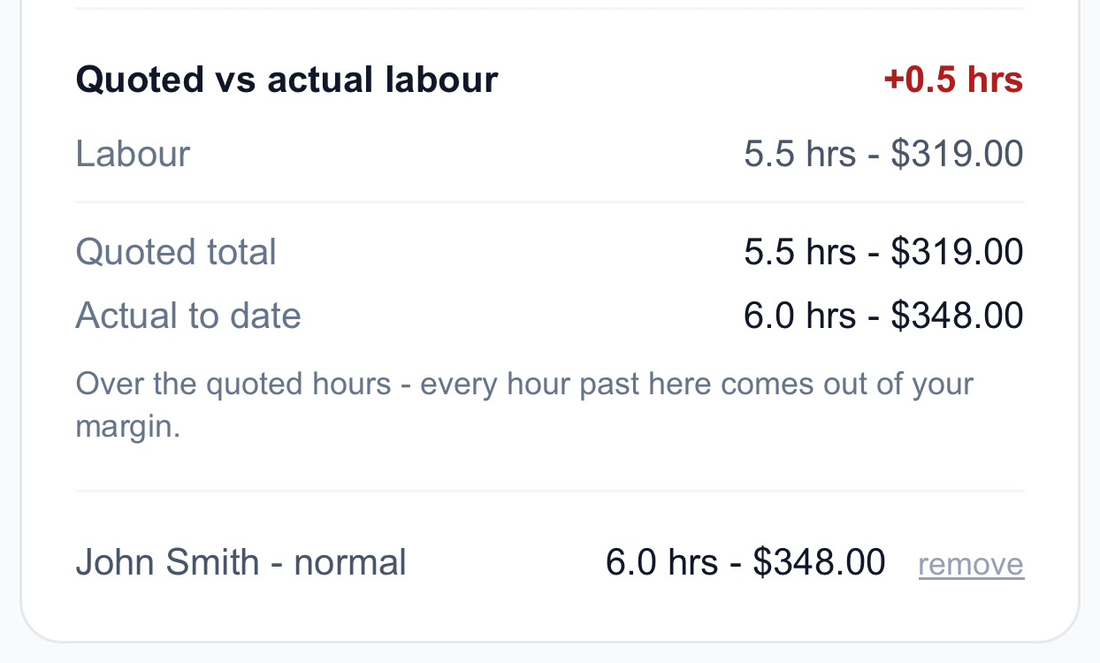
Clock on and the labour lands at that bloke's real cost rate, not an average. Add a part off the price list and it costs itself. This one has $270 of hours and $217.40 of parts on it, plus $167.28 of overhead, against a $1,189.90 quote.
Your real hourly rate
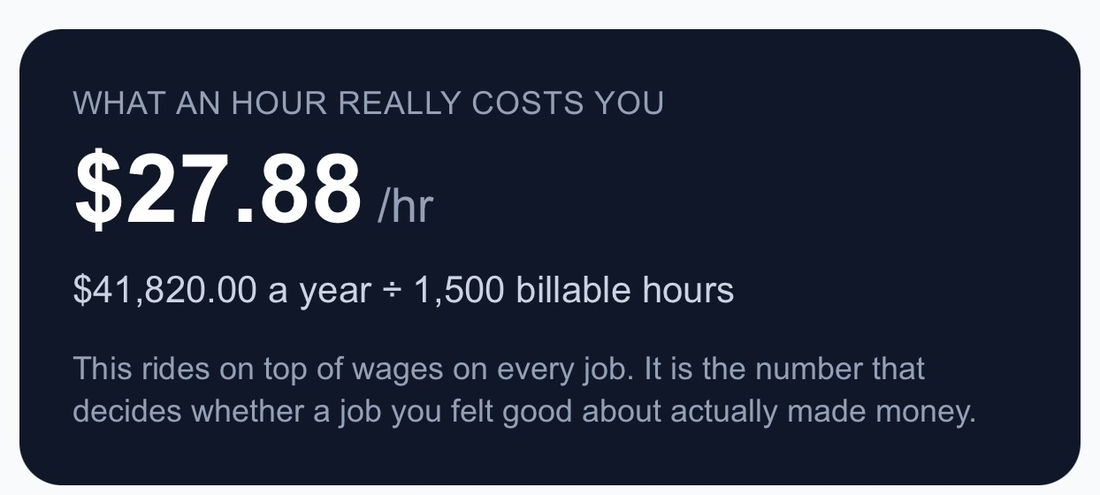
An hour costs you $27.88 before anyone picks up a spanner.
Put in the rent, the ute, the insurance and the phone bill, and it works out what an hour of overhead actually costs you. That number goes into every job automatically. Most blokes are carrying it and quoting as if they are not.
The diary
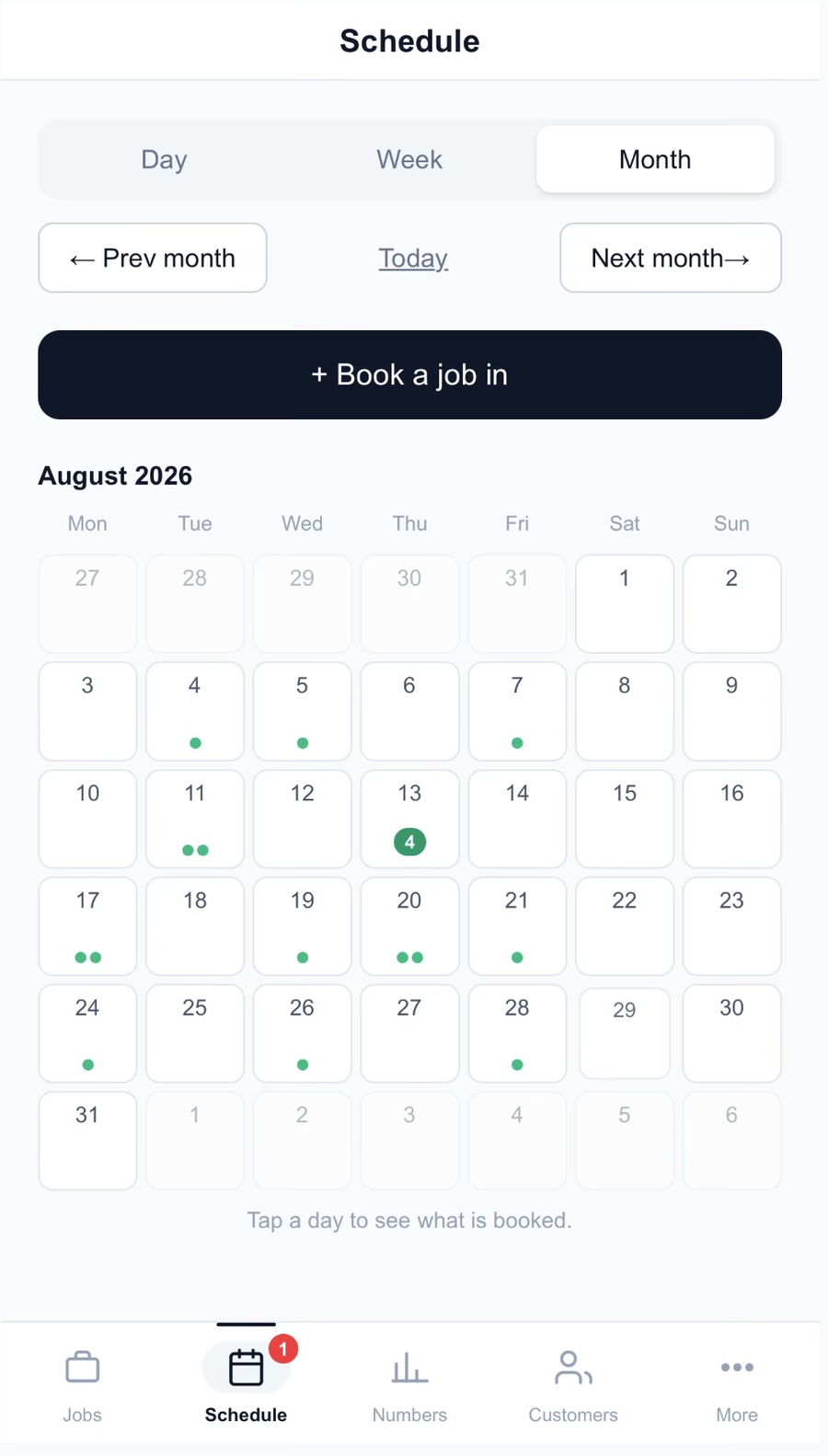
A month you can read on a phone.
Day, week and month. Put two blokes on the same job and it tells you before you double-book one of them. Every booking knows what that slot costs against the quote, so you can see a week that is full and still going to lose you money.
The thing tradies asked for most in demos, and the thing most job apps do worst on a phone.
Your crew
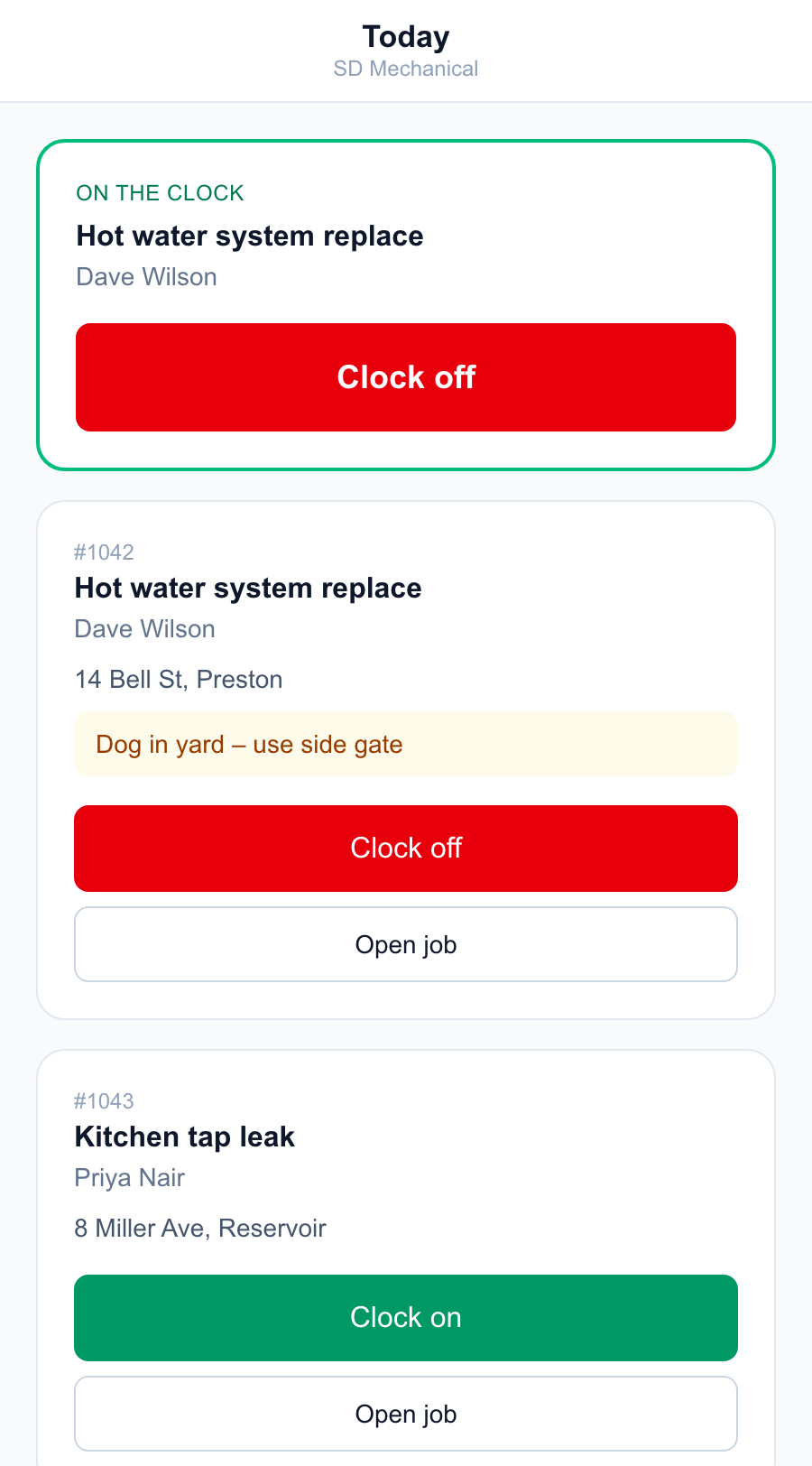
Your apprentice sees the job. Not what it makes you.
Field staff get one screen: what they are on today, where it is, how to get in, clock on, clock off. No costs, no margins, no invoices anywhere. You can hand the app to a second-year without handing him the books.
Getting paid
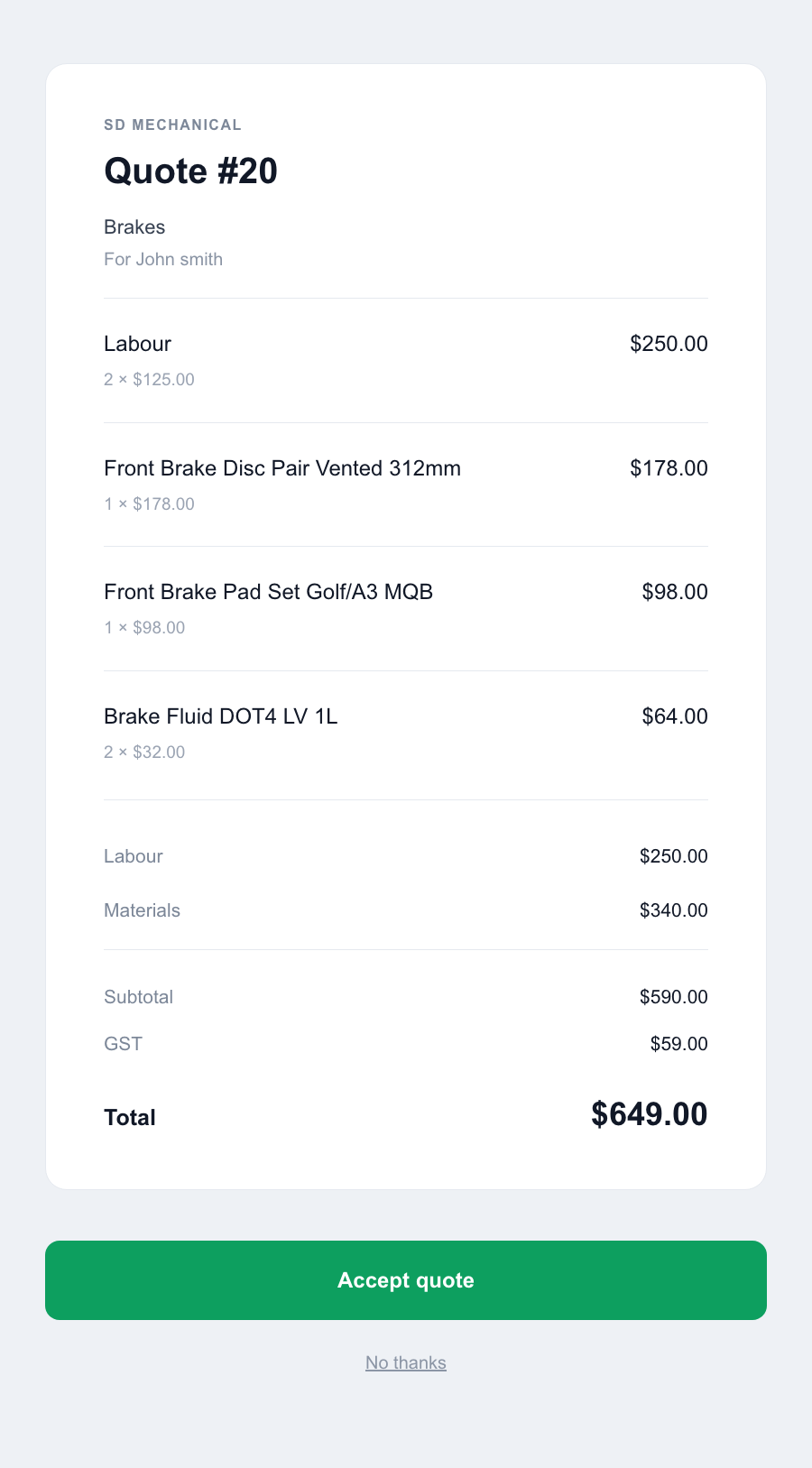
He accepts it on his phone. No login, no printer, no chasing.
Send him a link. He taps accept and the job moves on your side, so the first you know about winning it is the job changing status — not a voicemail you missed while you were on a roof.
Already paying for something
The two reasons blokes move.
“It costs me more every time I put someone on.”
Take on an apprentice in February and your software bill goes up in February, months before he is worth what you are paying him. Put a labourer on for six weeks over summer and you either carry that seat all year or you share a login with him.
Once two people share a login you cannot tell whose hours are whose, which is the exact number you need to know what the job cost.
Here you pay on how many jobs you run in a month. Your crew are free. Their hours are the whole point of the thing.
“It only really works on the iPad in the office.”
A lot of this software was drawn for a desktop and then shrunk onto a phone. So the tablet lives in the ute, the job gets written up on Friday, and Wednesday's hours go in from memory.
Hours from memory are always round numbers. Round numbers are always wrong.
This was drawn on a phone first. Add it to your home screen and it opens like any other app. There is no tablet to keep charged.
Coming off something else? Here is the honest comparison.
Built here
Built in Australia, by someone who does the BAS too.
GST that matches your BAS
GST is worked out once on the total, not added line by line and rounded four times on the way. A $383 quote shows $38.30 GST and a $421.30 total, and that is what lands on the invoice. Your bookkeeper will not have to fix it.
Words you already use
Quotes, variations, smoko. Nothing in here calls a quote an estimate or a variation a change order, because nobody on an Australian job site says that.
Email a bloke in your timezone
Support is me, in Sydney. You email at 7am and you hear back that morning, not overnight from a queue that has already gone home.
Who is behind it
One bloke, and the jobs that caused it.
I am Samuel. I write the app, the site and the support replies. There is nobody else.
This started because I kept finishing jobs that felt alright and were not. The quote looked healthy, the work went fine, and then the hours and the parts landed and there was a couple of hundred missing. Every time I found out weeks late, when the only thing left to do was cop it.
What I wanted was the number moving while the job was still open. The tools that did anything close wanted paying per head for it, which is backwards when the whole point is getting your crew's hours in.
It is early. I would rather say that than pretend there is a support team behind me. What you get instead is me on the email and changes that land in days, because there is no roadmap committee to go through. If something is broken, tell me and it gets looked at that week.
Have a poke around a demo business first.
Jobs, quotes and margins already in it, so you can see what it does before you type in a single customer of your own. If you like it, start yours and the first two months are free.
Two months free. No card up front. Leave whenever you like and take your jobs with you as a spreadsheet.
Straight answers.
Does it work with no signal?
Partly, and here is exactly where the line is. A job you have already opened stays on screen and stays readable when you lose bars, so you can still read the access notes in a basement. Clocking on and adding materials need signal to save. Typing everything in underground and having it sync when you come up is the next big build, and I am not going to tell you it works today when it does not.
Is the iPhone version as good as the Android one?
There is only one version. It runs in the browser and you add it to your home screen, so there is no separate iPhone build sitting six months behind, and no app store update for your crew to ignore for a fortnight. Whatever phones your blokes have, they all get the same screens on the same morning.
If I cancel, do I lose everything?
No. Export the lot to CSV — jobs, quotes, invoices, customers, time — and it opens in Excel or goes straight to your accountant. Your own history is not a hostage.
Does it do my BAS, or replace Xero?
No. This is the job side: what you quoted, what it cost, what you invoiced. Xero and MYOB are the books. Anything that claims to be both is usually rubbish at one of them.
What does it cost?
It goes on how many jobs you run in a month. A sole trader doing eight jobs pays less than a five-van outfit doing ninety, because that is the actual difference between them — not how many logins they have. Adding your crew is free and always will be.
How early is early?
Early. It is live and being used on real jobs, and it is written by one person. You will hit rough edges you would not hit on something ten years old with forty developers. What you get for that is the bloke who wrote it answering your email, and the thing you asked for showing up next week instead of next year. If that trade is wrong for you right now, better you know before you sign up.